
Barra de Navidad

"Zarpe" in hand, and water-maker repaired, we left Puerto Vallarta's downtown marina early, in anticipation of a 7 to 8 hours run to Ipala, a small indentation in the otherwise straight coast of this region. The weather forecast was benign, with predictions of 10 knots of wind with almost no waves, though I expected the constant old oceanic swell to roll us gently.
Our early departure got delayed almost immediately as when we arrived at the main port's channel we found it closed to allow an incoming cruise ship to berth. We waited patiently with an ever increasing flotilla of pangas, tourists and fishing boats for the cruise ship to finish its docking maneuver, before finally being released and allowed to continue our journey.

Despite the grey skies, Bahia Banderas was calm and we started making good speed. A few humpback whales came up around the boat, as if to welcome us back. We were finally moving, and heading south for good.

Coming out of the bay, we took a sharp turn towards the South East, in calm and pleasant weather, not too hot, not too cold. Then the afternoon breeze started coming in and we started registering much higher gusts than forecast. Our wind meter was reading steady 20 knots, gusting 25 to 27 knots -nothing huge- but certainly a lot more than anticipated. Slowly the seas started building up, short steep waves right on our nose, in a way that Enfin doesn't particularly like. To be fair, no boat likes heading straight into short steep seas, and most crews like it even less!
To make the whole picture more complicated, we had some old small swells from the North, on top of a large crossing swell from the South West, and those short steep new waves from the South East, making for a rather confused sea.
I tried bearing down towards the coast, tacking against the wind like a sailing boat would do, but there really wasn't much that could be done to make life normal on board. So we just kept going, in the hope that this would be no more than an afternoon breeze and the wind would die down at sunset.

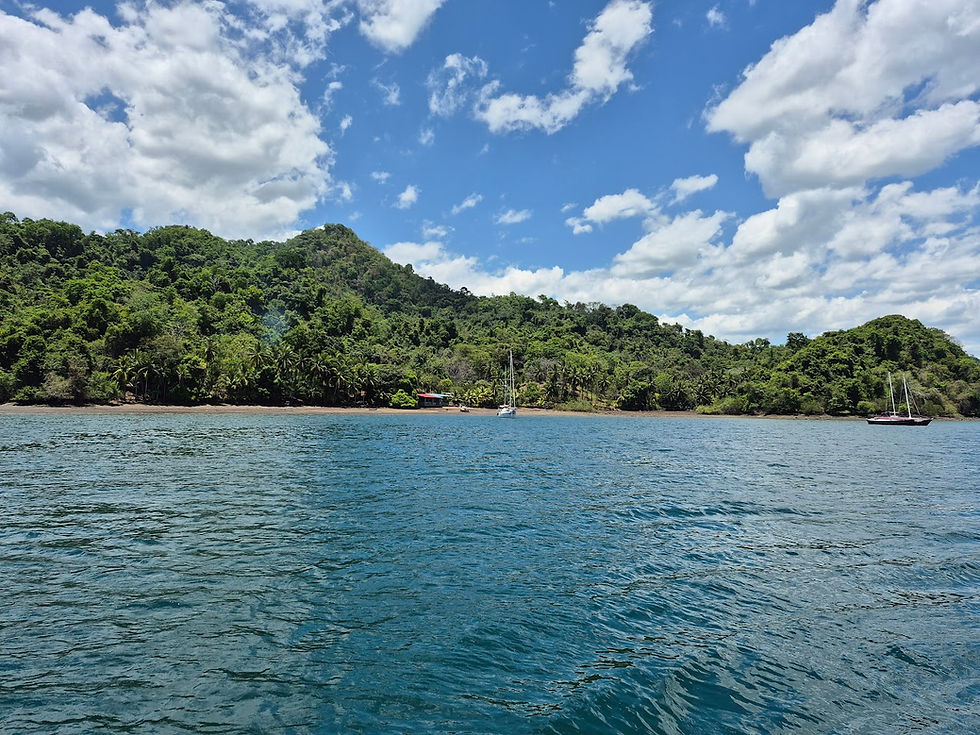
We made it to Itapa by mid afternoon, a couple hours later than anticipated, but unsurprisingly found that the precarious shelter it can offer in Northely winds was completely open in the current conditions. We slowed down to have a good look at the tiny bay, but the waves bouncing on the rocky shore made the whole idea of anchoring there for the night very unappealing, if not outright dangerous.
The overall lack of details on my charts didn't help. It's one thing to approach an unknown anchorage in good conditions to slowly scope it out using our own sounder and eye sight, a completely different one in waves and surf.

I knew the next good and safe anchorage, Barra de Navidad, was far away, a long overnight passage about 80 miles away, so Di and I agreed to keep pushing. The updated forecast was showing the local wind should die down around 21:00, so we were hoping our speed would come back up then.
Luckily, as the sun set, the wind started dying slowly. At first almost imperceptibly, but then more and more, until around 21:00 as predicted it had died. Slowly the short waves started melting away too, and life returned to our usual comfortable cruising mode.

Di grabbed about 5 hours watch overnight, to allow me to sleep. We normally set ourselves up on a 12 on, 12 off regime, but hadn't bothered initially since the initial leg was less than 8 hours. That meant I did the watch from early departure to 23:00, a long stretch, but in Enfin's comfy pilothouse not exactly a hard task.
Taking the watch over at 05:00 I made landfall at Barra de Navidad a couple hours later, while Di was sleeping soundly. By now the sea conditions had improved so much that she had chosen to sleep in her cabin rather than in mine. Hers, at the bow, is more comfortable with a "real" bed with a regular luxury mattress, but is unusable in any seas. Mine, low and in the middle of the boat, has a narrower foam berth to wedge yourself in, and is generally much better at sea.

Entering the lagoon just after sunrise was fairly magical. First, we were welcome by lush vegetation and tall coconut trees in what I imagined could be pilot's directions on my chart: "At the coconut trees, turn right to enter the lagoon". Then, as soon as we rounded the entrance, all swell and waves disappeared completely, and we found ourselves in calmer waters than those in any marina.
Since we'd spent so much time in marinas recently, we decided to forego the beautiful little marina at the foot of an old magnificent 5 star hotel and head instead further down the lagoon to find a secluded and safe anchorage.

Lowering the tender in the water to take Princess ashore for the first time in 24 hours, we had a nasty surprise. Our faithful Tohatsu engine, the one that had always started on first try even after long periods of inactivity simply refused to fire up. I tried basic diagnostics, but with Princess needing to go ashore, we lowered the kayak instead and took her for a well deserved walk.
The hotel grounds and the small village were perfect for tired and weary travelers. The lagoon is very picturesque with many restaurants on stilts over the water. Further away, towards the entrance, the lagoon branches off into a more populated area, with more activity and restaurants.
Seeing our tender troubles, a neighboring boat told us about a nearby mechanic, pointing us towards the beach with a first name "Alvaro". I'd pushed my diagnosing about as far as I could and figured that no fuel was making it to the injectors. (I've never liked working on outboards, I'm a large engine guy). Resolution would take another pair of eyes and hands.
So we headed ashore towards said beach and asked around for "Alvaro". He was "there", "just around the corner", "You can't miss him". But still we did. So the kind fishermen on the beach, repairing their nets after filleting their day's catch told us they'd let Alvaro know about our troubles, and he'd show up "soon".

Alvaro, busy with Sunday shopping, never showed up, but an ex employee of his, Luis, did. I showed him my diagnosis and how I'd reached it: He agreed with my basic premises that the fuel pump wasn't doing its job. Soon he was towing me back ashore and we were doing open heart outboard surgery right there on the beach.
It was very clear from his familiarity with my engine that Luis knew what he was doing, and with my limited Spanish, we were still able to communicate well about technical stuff. He was quite amused that I had a good understanding of what was happening and what to do, but that I just preferred working on larger engines.
Eventually we got the high pressure fuel pump out, took it up to his shed, surrounded by all sorts of old motors and spare parts, and tried reviving it.

Luis was extremely patient and careful and spent a good hour trying to unclog the pump, clean it, apply 12v to it to see if it'd run. Alas, to no good. That pump was dead as a Norwegian Blue Parrot. It is no more. It has shuffled off its mortal coil.
We reassembled the outboard, and Luis towed me back to Enfin, where Di and Princess were started to wonder if they'd get their evening walk or not.
For all his efforts, late on a Sunday, Luis wanted 200 pesos. About USD$10. Needless to say we added a decent tip to that before waving him good-bye. Both him and his young kid, who'd joined us on this evening adventure, smiling and waving back.

Being tender-less isn't a big deal. In fact, most of the landing spots on the coast suffer from heavy surf where an outboard is very dangerous and a kayak the much safer option. We hadn't used the tender in months, and I doubt we'll truly miss it in the coming weeks.
Of course I've ordered a couple spare high pressure outboard pumps, hopefully timing things right so they'll be waiting for us by the time we reach Chiapas. Just another thing to add to the sometimes quite complex logistical nightmare of competing necessities.
When preparing our passage, I need to find good weather windows, good landing beaches so we can try walking Princess daily, passages that are ideally not too long and allow for daylight arrival, sheltered bays that offer protection from the predominant swell and the daily winds. Add to that a package to "meet", finding potable water if we stay in a marina for long as well as getting fresh food regularly, and things get very complex very fast.
As I look ahead to the remaining hops to Chiapas, my chances of successfully combine all these get more and more unlikely.
After the days at sea and in the anchorage, we needed to refill our water tanks. The water inside the lagoon is muddy and would clog my primary and secondary filters fast, so instead we took the boat just outside for a few hours, to run the water-maker. It was the first time we truly pushed the unit beyond a simple test since I swapped the osmosis membranes and it turned out to be an unmitigated success! We were producing a steady 28 gallons an hour at a very low 60 ppm total dissolved salts (TDS), so we refilled out tanks very fast with pure clear fresh water.

Barra de Navidad was a really enjoyable stop where we got to refill our souls as well as water tanks. In different circumstances, we'd probably stayed longer, but we've still got a long way to go to Chiapas and the Mexican border, and now is the best time to cruise this part of the world.


When a vehicle breaks down unexpectedly, emergency towing can provide a practical solution for getting the vehicle moved safely. Having access to dependable towing support can make an already stressful roadside situation easier to manage.
Great post wish it was me, fair winds and flat seasseas ahead, Warren