
Tambor

As usual the plan was simple: Hop along the coast, stopping in nice and protected bays. Our next destination was Bahia Ballena, which on paper would provide good shelter from the Papagayo winds and seas.
Reality proved very different: After a night off Flamingo marina in constant swell, and a sporty beach landing for Princess' walk and a restaurant treat for all, we cruised all day and poked our nose into Bahia Ballena early afternoon.
Soon, it was clear that the large Southwesterly swells were coming in straight into the bay, creating huge surf at the beach. Worse, the middle section had very visible rocks with the angry sea exploding in huge plumes of white spray. A beautiful spectacle for sure, but not a welcome one when trying to anchor! Similarly, our potential anchorage spot was clearly very close to dangerous rocks, and the few boats at anchor already were being rocked by the waves.
"I don't like it" I said as soon as we looked in. Di, very simply, reminded me to trust my instincts, so after a cursory look I turned the boat around heading for the next possible shelter.
Even if we could somehow anchor, there is no way I'd be able to sleep in peace in such a precarious spot.
It was clear that nowhere on this part of the coast would be safe in the current swells, so we'd need to round the next cape before finding anything. The next large protected bay was a good 9 hours cruising away, but thankfully its approach looked very easy, with a fellow cruiser even commenting the approach could safely be made at night.
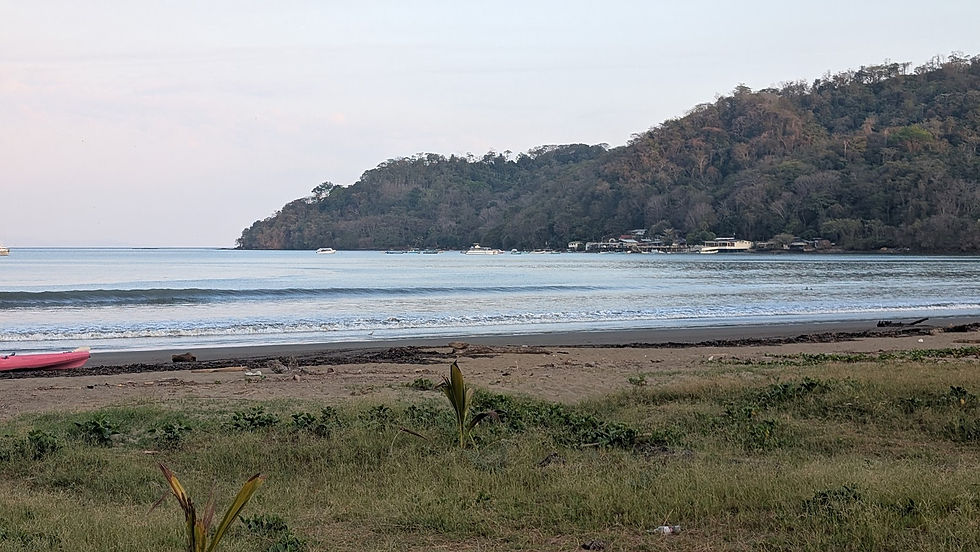
So, 9 hours later, in pitch dark and at very low speed we crept in to Tambor's main anchorage. Radar on a short range to pick up any unlit panga or boat in the anchorage, and projector light scanning our surroundings for extra security.
The anchorage was flat calm with no wind, and I anchored a little far from everything: We could always move tomorrow morning during daylight.
We'd finally escaped the constant Pacific swell, and it wasn't long before the whole crew was deep asleep after a very long day.

In the morning, I moved the boat closer to shore, still in 25 feet of water, and we all went ashore on our trusty kayak. The bay was calm, but that long deep swell outside was still raising some good surf ashore, making for a rather sporty arrival.

The little town is divided into 2 main portions: A fishing village and port, connected to the main section by a coastal road.
"Downtown", a short main street of a few blocks, has a few small tourist friendly restaurant, and a nice well stocked grocery store.
Liking what we saw we decided to make the bay our temporary home for a while. We couldn't use the tender for provisions in the surf, but by landing in the corner of the bay we could at least kayak and bring a few items at a time back in our dry bags during Princess' walks. A fun and different way to go grocery shopping.

We tried the local pizzeria, and whilst we had a good time and a very decent pizza, we were once again left speechless by how expensive things are around here.
US$60 for a pizza and soft drinks still feels expensive to us.
Days went by. Friendly locals waving to us and chatting with us, petting Princess. We moved to the other side of the bay on a couple of occasions to seek shelter from the afternoon waves, coming back to the main anchorage when the wind and waves would realign themselves later in the day.
The very long beach provided plenty of room for Princess to walk and play.
Walking in the shade under the trees, we saw beautiful ara macaws, (guacamayo in Spanish)) with bright colors on a mainly red plumage. Red ones are found on the Pacific Coast, whilst green ones are on the Atlantic side.

Looking at the chart further South, it didn't seem we'd get a lot of swell protection, so we decided our next stop would be in the Gulf of Nicoya, followed by a 5 day stop in Ocean Marina in Punta Arenas.

The gulf of Nicoya gave us some protection from the main swells, but the winds still managed to raise enough chop that we were happy to finally get into a marina after all these days at anchor.
Before arriving there we stopped at a beach just across Punta Arenas, where we got to see more howler monkeys. Funny little animals keeping a close eye on us, but otherwise not very concerned by our presence. They'd grunt as their name indicates, but no more than when we were back on the boat.
Our favorite was kayaking just under a tree overhanging the water, and looking straight up at them. In particular a couple of mothers carrying their tiny babies on their backs.

We crossed the bay towards Punta Arenas to arrive at 09h00 in the morning, having confirmed with the marina that we could arrive at any time we felt like, with no particular check in or check out time. A nice little plus in an otherwise expensive marina. Arriving early and leaving late in the day almost gives us an whole extra day to handle shore things, from groceries to restaurants.

The bay isn't difficult to navigate, but clearly the charts we have aren't very accurate, so we have to keep well clear of any indicated rock or obstacle, as well as keep our eyes peeled.
We're still a little traumatized by the misadventure our cruising friends on "Just Lucky" had when they hit a rock with their sailing boat, close to Papagayo marina. They're OK, and the boat has serious but non terminal damage, and will be repaired in Punta Arenas.
The rock they hit was charted on our and their Navionics tablet, but not on their helm's mounted chart plotter using the very same charts! I'm not sure why, but it does hammer the point that we need to use as many sources and displays as possible when navigating such poorly charted waters.

Adventure isn't always simple and straightforward. Sometimes the weather doesn't cooperate, sometimes the water is too silty to make fresh water, the waves too big to land ashore.
As they say in the marines, we adapt, we overcome, and in some ways it makes the memories even brighter.


Comments